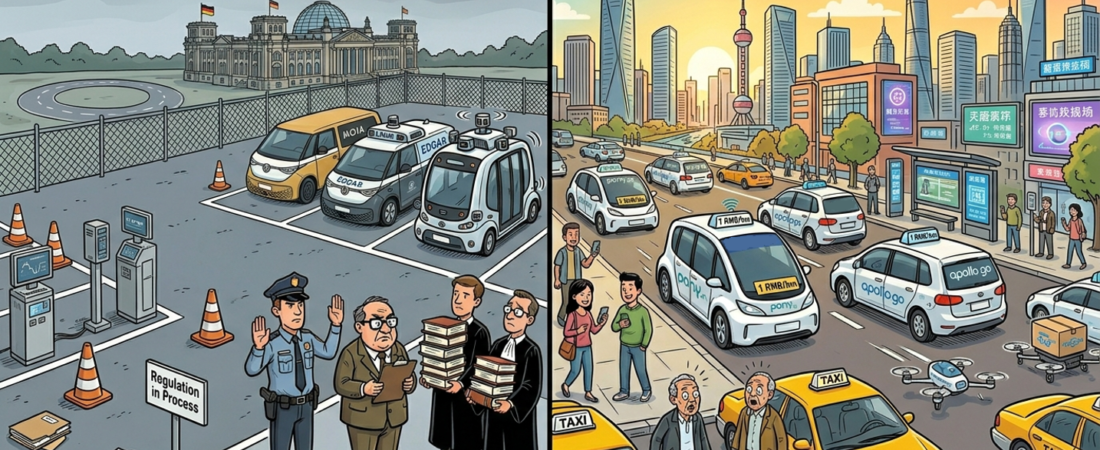
Why the future belongs to the (individual) robotaxi — and why Germany and the EU, weighed down by fragmentation, toxic regulation and over-engineered technology, risk losing the autonomous-driving race for good.
On 11 June 2026, a minivan called “EDGAR” drove three times along a roughly five-kilometer route through central Berlin, from the Federal Ministry of Transport to the Radialsystem cultural venue in Friedrichshain, without a human ever touching the wheel. On board: inspectors from TÜV, checking whether the vehicle obeyed every traffic rule. EDGAR, a research vehicle from the Technical University of Munich, had just completed the first Level-4 assessment drive in German real-world traffic. The TÜV association celebrated it as a milestone; its president, Dirk Stenkamp, declared that autonomous driving is technically possible even in complex city traffic. In plain terms: it was the driving test a learner takes — passed by a research prototype, and hailed as a breakthrough.
Let’s look at the rest of the world on that same day:
- Baidu’s Apollo Go handles more than 250,000 fully driverless rides a week (peaking above 350,000 in March 2026), has delivered over 20 million rides to the public, has logged more than 300 million autonomous kilometers — over 190 million of them fully driverless — and runs its Wuhan service at a per-vehicle profit.
- Waymo runs around 500,000 paid rides a week with a fleet of roughly 3,000 vehicles across eleven U.S. cities, and is targeting one million rides a week by the end of 2026.
- Pony.ai reached unit-economics breakeven in Guangzhou and Shenzhen within four months of launching its seventh-generation robotaxi.
Thousands of robotaxis are in commercial service across China and the U.S. — in China, already profitably. In Germany, we celebrate a prototype passing its driving test. The uncomfortable truth: Europe is on the verge of losing the autonomous-driving race for good.
Fully autonomous individual robotaxis — with no safety driver — are already reality in China
What feels to a European tourist like a trip into the future is everyday life in China. The scene is Wuhan, a city with around 17,000 conventional taxis, where Baidu’s Apollo Go runs a growing driverless fleet. The base fare is a few yuan; the same trip with a human driver costs many times more (though it’s still far cheaper than European taxi rides). However, Baidu’s white robotaxi fleet in Wuhan is now profitable, and so is Pony.ai. Local taxi drivers have filed a petition asking for the service to be capped: “they’re taking the rice out of our bowl,” one user wrote on Weibo.
What passengers love about the white cars: no small talk, no smell and no detour to run up the fare. Privacy and directness — plus shorter waits, because robotaxis never sleep; they only need to recharge in off-peak hours.
What is China’s lesson? First: autonomous is the future — autonomous, dirt-cheap, and already working. Second: it is not pooling. It is the individual robotaxi, and the reasons people love it are precisely the ones sharing can never deliver. Third: the Chinese competitors, scaled on the cheapest mobility market in the world, are already looking at Europe.
Pooling is an expensive dead end with no customer value
Europe’s big providers, meanwhile, are betting on pooling concepts with small minibuses. The entire European pooling narrative rests on a quiet equation: autonomy plus sharing equals the sustainable, city-friendly, transit-compatible future. It is driven by the regulatory environment, especially in Germany, where individual concepts face a consumer-unfriendly return obligation after each ride. But sharing at the trip level was never a consumer preference. It was an economic necessity of the driver era: a human driver is expensive, so you fill the vehicle to spread that cost across several heads. The same logic applied to sensor technology. Autonomy removes the driver; scale and technological progress drive down sensor costs — so the original reason to pool disappears.
A study I co-authored at Strategy& back in 2019 already showed a clear pattern in a conjoint analysis: consumers never prefer sharing for its own sake. They accept it under only two conditions — when it is noticeably cheaper, or when no individual alternative is available.
- Germany: shared robotaxis are seen as an acceptable form of mobility — but only at prices below individual offerings. Even tech enthusiasts will pay nearly the same price for a shared concept only as long as no non-shared alternative exists. Translation: sharing is the tolerated second choice, not the wish.
- USA: pooling concepts are seen to have far less market potential — unless they compete on very low prices. The affluent first movers explicitly want the premium individual product.
- China: pooling becomes a viable alternative only when clearly positioned below the individual service. At transit-level prices the robotaxi reached preference shares of up to 65% — but at prices that are commercially impossible to sustain.
For intercity trips the picture is even clearer: here the individual robotaxi wins decisively, privacy, space and comfort become the deciding factors, roomy bodies (MPVs, SUVs) win, and shared shuttles fall behind.
Add the underlying mood: 49% of Germans, 53% of Americans and 90% of Chinese were open to robotaxis. Around 30% of trips could be captured at the right price — but roughly half of consumers don’t want to give up their own car. What people want is autonomous, door-to-door, private. Sharing is the compromise, never the starting wish.
Pooling has only one argument: price
Strip away the sustainability rhetoric and pooling is left with exactly one lever: a lower price per trip. Comfort, privacy, directness (no detours, no strangers climbing in), reliability, time savings — all of it argues for the individual concept. The study confirms pooling consistently, and only, as the cheaper option.
Pooling, then, is not a mobility concept. It is a price product.
And a second argument often attributed to pooling doesn’t hold either: the ecological advantage. There is no meaningful CO₂ penalty for the individual concept, because all these vehicles run on electricity anyway. The one justification for forcing people into shared seats — “but it’s greener” — evaporates when the individual ride is also a BEV.
But if pooling exists solely on price, then its entire viability depends on staying permanently and noticeably cheaper than the individual offering. The moment individual robotaxis become cheap enough, the only reason for its existence disappears.
And this is exactly the argument the Europeans lose
If price is the only battlefield, then cost per kilometer decides everything — including the pooling segment itself. And you win cost per kilometer with cheap mass-produced vehicles and economies of scale, not with clever bundling algorithms.
Our study revealed the decisive number back in 2019. In Europe, a 5 km taxi ride had a cost of around €12.30. In China, the comparable taxi ride is only around €3.40. A robotaxi price 50% cheaper than a taxi gets you get a preference share of around 34% of all urban rides in China. And, in Europe, the price elasticity is also brutally clear: once robotaxis drop below the €1/km threshold, demand tips over; at a price 20% above public transit, a 28% preference share is realistic in Europe.
Seven years later, that forecast is reality. Current market data shows the gap in black and white: a robotaxi ride in China today costs around 1 RMB per kilometer. Waymo operating costs are estimated at roughly $1.36–1.43 per mile in the U.S. by Morgan Stanley, Tesla at around $0.81 per mile. Baidu — in Wuhan, where taxi tariffs already sit 30% below those of China’s tier-1 cities — became the first provider to reach unit-economics breakeven. Baidu CEO Robin Li projects that operating costs for their fleets will fall to the equivalent of $0.25 per mile by 2030, with a forecast five- to seven-fold rise in demand.
The honest reading of this data: whoever industrializes the cheapest individual robotaxi at Chinese scale captures the mass market — and simultaneously undercuts Europe’s pooling providers in the one discipline they have, price, without their comfort penalty.
Scale advantages and mass production at Chinese dimensions. Sheer scale flows directly into price per kilometer and into margin. A European niche player with a few thousand handcrafted vehicles is in a different league from a Chinese actor driving down unit costs on a home market of over a billion people at rock-bottom prices. Every European concept today is hand-built work on an expensive technical base, while Chinese counterparts increasingly come directly off the regular mass-scale OEM assembly line.
So the German challengers bring a price product into a price war they cannot win on price.
And the stakes are enormous: the global autonomous taxi segment is currently projected to reach ~$400 billion by 2030 by Goldman Sachs and McKinsey — growing at a massive CAGR. That is precisely why losing this race to Chinese individual robotaxis would be a total write-off.
The second wrong-way reflex: overly complex technology
So far this has been about concept (individual vs. shared) and cost. But there is a third level on which Europe risks falling behind — and it is the one most underestimated in the German debate: technology strategy. Here too, Europe systematically chooses the path that looks most convenient for domestic approval — and yet risks to lead into a global dead end.
Simplified, four architectural philosophies face off:
The four schools of autonomous driving
| Dimension | Mobileye / MOIA | Waymo | Tesla FSD | Chinese models |
| AI paradigm | Rule + ML hybrid (RSS) (with trend towards more end-to-end neural network components) | Foundation model (LLM/VLM) | End-to-end, camera-based | End-to-end neural nets, BEV + Transformer, increasingly world models |
| Sensors | ~13 cameras + LiDAR + radar | 13 cameras + 4 LiDAR + 6 radar | Cameras only | Multi-sensor (camera + LiDAR + radar), rapidly falling cost |
| Maps | Crowdsourced HD maps (REM™) | Proprietary HD maps | No HD maps / Online spatial modeling | Increasingly map-light (BEV generalisation) |
| Business model | B2B turnkey for third parties | Own platform | OEM-integrated | Vertically integrated, city-by-city replication |
| Strength | Transparency, approvability | Proven multi-million scale | Cost efficiency, data flywheel | Cost, learning curve and scale |
| Weakness | Less autonomous learning, complexity | High cost, black box | Edge cases in poor weather | (Still) home-market focused, International scaling hurdles (regulatory/data sovereignty) |
The rule-based approach (Mobileye/RSS): Responsibility-Sensitive Safety declines to predict human behavior (which Mobileye regards as inherently error-prone) and instead works with a formal, mathematical, parametric model of safety distances that regulators can tune market by market. It is transparent, auditable — and therefore attractive for European approval. That is precisely its strength, and its trap.
The end-to-end approach (Tesla, and in more radical form the Chinese providers): here a neural network learns to drive largely straight from raw data, without every driving decision being cast into explicit rules. Xpeng, NIO, Li Auto and Huawei have brought BEV + Transformer into mass production; Xpeng moved to a single-stage end-to-end architecture in 2024 and already works with generative world models. Pony.ai uses reinforcement learning and world models to master even rare edge cases.
Waymo sits in between: more AI-powered than Mobileye (a foundation model built on LLMs/VLMs), but expensive (a single vehicle reportedly costs ~$160,000) and, as a black box, also hard for regulators to validate.
The uncomfortable hypothesis
The rule-based, sensor-redundant approach looks attractive for European compliance — it is explainable, it fits the German need for demonstrability, and it should win MOIA EU type-approval, probably in 2027. But:
Over the medium and long term, the learning, end-to-end-driven Chinese models will win out. They scale their capability with data and fleet size — and the Chinese have both in abundance. A rule-based system improves when engineers add new rules; a learning system improves by driving. On a market with more than a hundred cities of over a million people as a training environment, that is a structural advantage Europe will not close with rulebooks.
So the same pattern threatens in technology as in concept and price: Europe optimizes for the local compliance optimum, sinks into complexity — sensors, rulebooks, sensor fusion, 27 national approval logics — and falls further behind over the medium term, while competitors’ learning curves run exponentially. The rule-based approach isn’t wrong; it is just a bridgehead, not a destination. Mistake it for the destination and you build the next dead end.
The uncomfortable truth behind it: the software is missing
But the technology choice is not only a question of strategy — it is also a question of capability. And here lies an admission the German debate prefers to ignore: the domestic champions don’t even possess the decisive competence themselves. The core of autonomous driving is the driving software — and at MOIA that isn’t supplied by Volkswagen but by the supplier Mobileye. After the CARIAD debacle, which blocked the group’s software roadmap for years, that’s understandable but strategically fatal: VW supplies the hardware combination of vehicle and sensors — the discipline it masters — while the value-creating, learning layer comes from a third party. Whoever doesn’t own the software doesn’t own the data flywheel; and whoever doesn’t own the data flywheel cannot take part in the learning curve that decides this race. The Chinese providers and Tesla are vertically integrated — they own vehicle, sensors, software and fleet operation in one hand and close the learning loop entirely in-house. The European approach splits exactly this chain into hardware supplier, software supplier and mobility platform — giving away the integration that would be the real competitive advantage. Tellingly, MOIA shut down its remaining in-house ride service in Hanover in summer 2025 without notice, with vehicles that didn’t even carry the necessary sensors.
Vehicle and cost comparison
| Chinese robotaxi (e.g. Baidu RT6) | Waymo (6th gen) | EU taxi (human) | |
| Vehicle incl. AV system | < $30,000 (full package) | ~$160,000 (incl. AV kit ~<$20k) | n/a |
| Cost per mile (service) | ~$0.35* | ~$1.36–1.43* | ~$2.00 (equals US ride-hailing) |
| Taxi ride, 5 km (ref. 2018) | ~€2.00 | – | ~€12.30 (EU) |
| Scaling logic | Vertical integration, city-by-city | Own fleet, capital-intensive | – |
| Status | Profitable in Wuhan (unit-economics), >250k rides/wk | ~500k rides/wk, not profitable – targeting 1M rides/wk by end of 2026 | – |
Figures are order-of-magnitude values from publicly available 2025/26 sources; cost-per-mile and end-customer price are not interchangeable; passenger costs may include subsidies.
The message of the table is unambiguous: the decisive lever is the vehicle and system cost base, and there China leads by a factor of five — not because of better algorithms, but because of vertical integration, volume and a supply chain no European niche player can replicate.
Free float vs. return-to-base: what it means per kilometre
On top of this already unfavorable cost base, Germany adds a regulatory surcharge. In free-float operation (as Chinese and U.S. providers run it), a vehicle waits after drop-off at the next demand point or takes the nearest job. Under the return-to-base obligation of German hired-vehicle law (the Rückkehrpflicht), it must return to its operating base whenever it has no follow-on booking. That systematically generates two empty trips per job instead of one repositioning — roughly a doubling of the empty-kilometer share, depending on city structure. In a business whose entire viability hangs on cost per kilometer, that isn’t a detail — it’s the neck. The only individual robotaxi operation German law permits today is, by construction, the least economical in the world.
The self-built trap: over-regulation and fragmentation
Here Europe engineers its own defeat — twice over.
Germany regulates the individual robotaxi into unprofitability. The Passenger Transport Act (PBefG) essentially recognizes, for individual trips, the hired-vehicle category (§ 49) — including the return-to-base obligation. The only category without a return obligation — and eligible for public-transit funding — is the pooled on-demand service created in 2021 (§ 50). In other words: pooling. German law all but drives its own champions into pooling. The very format the world market won’t reward is the only one German law makes economically legal. That’s the trap: a regulatory local optimum that is a global dead end.
Europe fragments the market into 27 legislations. Service licensing — the commercial regime under which a robotaxi may carry passengers — is precisely not EU-harmonized. The UK already built a format-neutral approval regime with its Automated Vehicles Act 2024, overriding the old taxi-protection rules for autonomous services; France created its own AV path. Even within Germany, the operating-area approval — as the Berlin EDGAR drive showed — is a case-by-case demonstration per city area. No European operator can scale across borders the way Waymo does across U.S. states or a Chinese actor does on its billion-person home market.
And both traps reinforce each other into a chicken-and-egg problem. Germany demands the safety case before it permits driverless regular operation — yet that case can only be made in driverless regular operation. Waymo and Baidu were allowed to drive publicly for years in permissive environments like Arizona or Shenzhen, to fail, iterate and gather data; out of that came the safety case. The German framework reverses the order and closes the learning loop before it can begin. The numbers prove the blockage: since the AFGBV came into force, the Federal Motor Transport Authority (KBA) has issued 129 testing permits — but only 35 of them for Level 4 (as of July 2025), and not a single vehicle runs in commercial regular operation without a safety driver. Five years after the world’s first L4 law, Germany stands at zero commercial driverless trips, while Apollo Go alone handles more than 250,000 a week.
The framework isn’t ill-intentioned — but it is structurally hostile to scaling. Even the industry meant to use it is calling for a rebuild: in its February 2026 position paper, Bitkom lists the brakes in detail — double checks, where the operating-area approval demands safety proofs the KBA already examined in the operating license; a rigid full inspection every 90 days despite continuous on-board self-diagnosis; and above all the fact that every extension onto adjacent streets triggers a de facto re-approval, including revision of all the registration documents. On top comes an unresolved liability question: strict, no-fault keeper’s liability still applies. Whoever is liable as the operator but doesn’t control the software bears a barely calculable risk. Each of these points is small on its own; together they make an approval regime in which scaling gets more expensive, not cheaper, with every additional street — the exact opposite of the learning curve running in Wuhan and Phoenix.
It is the same pattern we see in autonomous driving as a whole and in eVTOLs: Europe regulates the experiment to death while others industrialize.
The wrong-way driver isn’t driving against traffic out of malice — he’s convinced he’s going the right way.
The likely endgame: DiDi arrives — individual, not pooled
The endgame can already be sketched today. Chinese actors — DiDi, Baidu Apollo, WeRide, Pony.ai, Momenta, riding on the vehicle platforms of BYD or Geely — are perfecting their cost per kilometer on the cheapest mobility market in the world. The harbingers are already here: Uber and Shanghai-based Momenta plan Level-4 test rides in Munich in 2026; Baidu and Lyft plan driverless taxis for the UK and Germany; WeRide is in Abu Dhabi; Baidu is cooperating with PostBus in Switzerland. After a ramp-up and homologation phase they will enter Europe at full competitive strength and work their way through the fragmented regulation country by country — exactly the script the Chinese BEVs have already written.
The global markets will not change their route towards pooling. The global champions from China and Mountain View will push to bring cheap individual rides that undercut both taxis and European pooling champions at the same time. Tariffs and regulation will slow them, not stop them — we know that too well from the BEV market. If regulators continue to mandate pooling, it merely confirms that Europe is locking itself into a regulated, subsidized niche while the open world market moves toward the individual concept. The warning of my 2019 study becomes the reality of 2030: autonomous driving becomes China’s game (the actual title of the paper).
What Europe and its OEMs must do now
- Reposition pooling strategically. It is an introduction and transition product, not the default on which to build a global champion strategy. At best it is a subsidized municipal service to create the preconditions and experience for a broader roll-out — for the last mile, rural areas or night service. A public mandate, not a global business. Take the iconic buses to build your brand – but prepare the transition to mass-market robotaxis now!
- Fight where it’s decided: on cost and scale. Either build genuine low-cost robotaxi vehicles at volume (painful for the engineers of German premium OEMs) — or deliberately partner for vehicle and platform (including with Chinese providers) and differentiate elsewhere. Mercedes and BMW already gave away digital customer access once, by selling FreeNow and exiting Tesla — that mistake must not repeat.
- Orient technology toward the lead markets. Use the rule-based approach as a bridge, not a destination. Trade approvability for learning ability and you win the permit and lose the decade. Data flywheels, end-to-end architectures and map-light generalization are the direction — partnerships with leading stacks are a legitimate and often fastest way there. But whoever permanently supplies only the hardware and leaves the driving software to third parties hands over the data flywheel and with it the learning curve. The competence gap after the CARIAD debacle is a problem to be closed, not a permanent state; at minimum, control over data and fleet learning must stay in-house.
- Take the defensible premium flank. The 2019 study showed a real, small but high-margin market for premium robotaxis (around 8% preference share, price premium justified), a clear preference for the individual concept on long distances (comfort, space, privacy) and high appeal of value-added services (around 75%). Here, via brand, experience and ecosystem, not cheap urban pooling, Western OEMs can actually set the pace with existing premium product substance.
- Fix the regulation — or it becomes an own goal. Harmonize the European service regime, remove the return-to-base trap for autonomous vehicles, and introduce a format-neutral AV approval regime on the British model, so the individual robotaxi is even economically legal at all. Above all, break the chicken-and-egg problem: explicitly permit driverless testing, pool approval authority nationally in one central body (instead of case-by-case per city), scrap double checks, and make operating-area extensions a lean procedure. Without data from real driverless operation, the safety case the same framework demands never arises — the learning loop must be allowed to begin before others have closed it beyond reach. Otherwise Europe regulates its own providers into the niche and at the same time leaves the front door wide open for Chinese robotaxis. This insight isn’t new either: build relationships with regulators early; regulation can even promote robotaxis (dedicated lanes, preferred access).
Wrong-way driver, or change of direction?
My 2019 hypothesis has been confirmed by market reality. While car sharing failed, autonomous robotaxis will deliver the breakthrough for MaaS (Mobility-as-a-Service). Robotaxis are becoming individual, reliable and cheap. China is building for that — and is already profitable in Wuhan. The U.S. is building for it (Waymo, Tesla). Europe regulates for pooling, optimizes its technology for approval instead of the learning curve, fragments itself into 27 legal spaces — and tells itself the rest of the world is going the wrong way.
The ghost driver always thinks that. On 11 June, a research vehicle passed its driving test in Berlin, while in Wuhan, Phoenix and San Francisco commercial reality has long been running. Europe has a short window to turn around: harmonize, scrap the return-to-base obligation, unleash the individual format, dock technologically onto the lead markets, and compete on scale and premium. Or it watches its champions get pushed into a subsidized niche while Chinese individual robotaxis take the open road.
Data basis: Strategy& / PwC, Playing China’s game – Global Consumer Survey on Autonomous Driving (2019); 3,000 urban car drivers in Germany, the U.S. and China, incl. conjoint and Van Westendorp analyses. Current market, technology and cost data (2025/26) from publicly available sources (incl. Baidu/Apollo Go, Waymo, Pony.ai, ARK Invest, TÜV association / TU Munich on the Berlin assessment drive of 11 June 2026, McKinsey, Goldman Sachs, Morgan Stanly, Bitkom). Regulatory framing: PBefG §§ 49/50; UK Automated Vehicles Act 2024; LOM France.