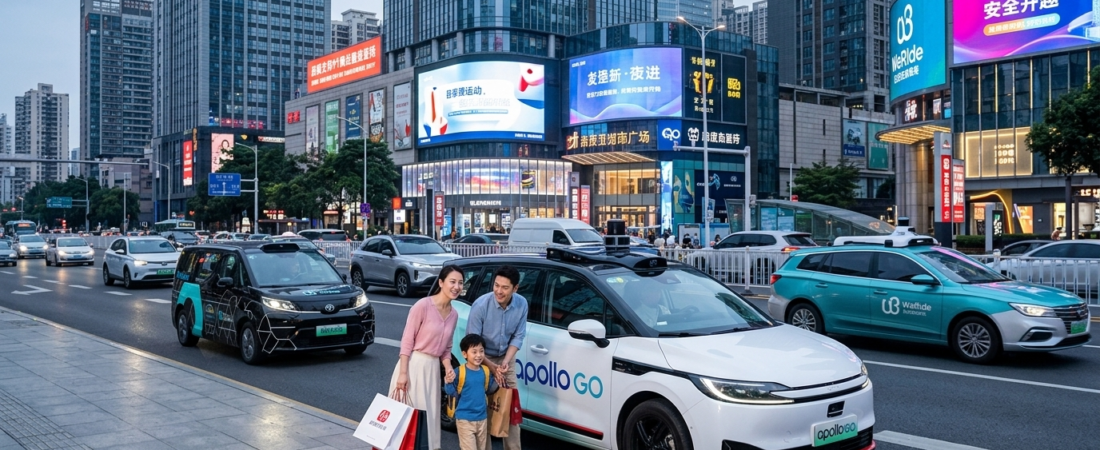
While European automakers debate Level 3 highway pilot features at 60 km/h or even revert their offering to Level 2++, Baidu’s Apollo Go is completing over 250,000 fully driverless rides per week across 22 Chinese cities. Waymo is serving more than one million rides per month in the United States. Pony.ai completed its Nasdaq IPO in 2024 and is expanding internationally with Toyota as a partner. WeRide has entered Abu Dhabi and most Chinese players are eyeing Western / European markets leveraging strategic partnerships with Uber and Lyft. The robotaxi revolution is no longer a future scenario. It is happening now — just not in Europe.
The Wake-Up Call Europe Refuses to Hear
I have been tracking this development for nearly a decade. In 2019, I spearheaded a global consumer survey at Strategy& that investigated consumer acceptance, pricing thresholds and substitution effects of autonomous mobility services across Germany, the United States and China. The findings were unambiguous: 90 percent of Chinese consumers were open to using robotaxis once available, compared to roughly 50 percent in Europe and the US. The research also showed that price would be the decisive factor for mass adoption — and that Chinese price levels for mobility services were already up to 70 percent below European equivalents. We published “Playing China’s Game” — forecasting that Chinese robotaxi players would become the global pacesetters and eventually expand to Western markets with radically lower price points. Yet, at the time, most European industry experts dismissed this scenario. Today, the scenario is no longer a forecast. It is reality.
China’s Players have created Structural Advantages that Cannot be Replicated in Time by Western Competitors
China’s dominance in autonomous mobility rests on four structural pillars that no European country can replicate through regulation or subsidies alone.
First, scale. China has more than 100 cities with populations exceeding one million. Each city is a natural testing ground for autonomous technology. A robotaxi pilot in Wuhan generates more ride data in months than a comparable project in Munich would in years.
Second, cost. Baidu’s sixth-generation robotaxi costs approximately $28,000 — down from over $200,000 just six years ago. Rides in Wuhan cost between 4 and 16 yuan for a ten-kilometer trip, a fraction of a conventional taxi fare. Baidu’s CEO has projected that US robotaxi costs could fall to $0.25 per mile by 2030, triggering a five- to sevenfold increase in ride-hailing demand.
Third, ecosystem maturity. Nearly 550 million Chinese consumers already use taxi and ride-hailing apps regularly. The infrastructure for booking, payment, routing and fleet management exists at scale. The transition from human-driven to autonomous rides is operationally seamless.
Fourth, government alignment. China aims to be the global leader in autonomous driving by 2030. Cities provide dedicated testing zones, fast-track permits, and supportive regulation. European regulation, by contrast, remains fragmented across 27 member states with no unified framework for Level 4 deployment.
The European Playbook is Failing
European automakers are not standing still. But they are fighting the wrong battles with the wrong tools.
Volkswagen invested billions in its CARIAD software unit — and ended up partnering with Rivian and XPENG after years of delays, software bugs and missed milestones. Mercedes proudly downgraded its 60 km/h Level 3 highway pilot to Level 2++ — a technological achievement that amounts to a pocket calculator in a world of smartphones in the eyes of Chinese consumers. BMW pragmatically adopted NVIDIA’s Drive platform, effectively conceding that proprietary autonomous driving stacks are not viable for German OEMs.
On the mobility services front, the failures are even more painful. Mercedes and BMW sold their FreeNow platform — the digital gateway to the European customer — to Lyft for a fraction of the investment it had consumed. In doing so, they handed the keys to the European mobility ecosystem to a company now partnering with Chinese robotaxi providers. MOIA has not moved beyond pilot status in Hamburg after years of operation. Other players like Benteler’s HOLON, ZF’s Oceaneering or the French EasyMile do rather focus on „Ride-pooling“ with shared autonomous shuttle concepts favored by EU’s AFIR regulation and local transit laws rather than „Ride-hailing“ with private concepts. A niche that Chinese private robotaxi providers will undercut and outscale within years due to cost advantages and scale.
The pattern is consistent: European players invest heavily, move slowly, lack software competence, and ultimately retreat or sell at a loss. They build premium products for a market that demands competitive pricing. They optimize processes when they need radical reinvention.
The Consumer Does Not Care About Brand Heritage
Our consumer research revealed an inconvenient truth for European OEMs already in 2018: globally, about one-third of consumers were undecided whether to trust traditional automakers or digital pioneers for autonomous driving. In China, 30 percent of respondents trusted Baidu most — more than any established car brand.
The findings also shattered the assumption that consumers are emotionally attached to car ownership. When robotaxis were priced competitively — approximately 20 percent above public transport — 29 percent of respondents across all regions preferred them as their primary commuting mode. Among young urban singles, 76 percent could imagine giving up their car entirely once robotaxi services were widely available and reliable.
For European OEMs, this means the premium brand premium is eroding in mobility services. Nobody chooses a robotaxi because it carries a Mercedes star or a Volkswagen / Moia badge. They choose it because it arrives in three minutes, costs less than driving, and provides a comfortable ride. Price, availability and service quality trump brand heritage.
What Winning Looks Like: Six Principles for European Mobility Players
Based on nearly two decades of experience spanning OEM operations, strategy consulting and hands-on transformation work, I have distilled six principles that separate winning mobility strategies from expensive failures.
1. Understand your consumer — deeply, qualitatively and quantitatively. Product and service concepts must be derived from rigorous consumer research, not boardroom assumptions. Our research showed that consumers want differentiated concepts: small, economical robotaxis for city rides, but spacious and comfortable vehicles with premium features for longer distances.
2. Design products and services right — from a zero baseline. Products and services must generate superior customer experience based. Leverage generated consumer insights and Co-Creation approaches to define concepts right. Applying Tesla’s “Five Principles” approach — making requirements less rigid, maximizing accountability, simplifying designs, accelerating cycles, and automating relentlessly to radically reduce costs and prices — is not optional for European players. It is existential.
3. Master price levels and cost structures. A 5-kilometer taxi ride costs €12 in Frankfurt and €3.40 in Shanghai. To compete with Chinese players expanding globally, European providers need cost reductions of 30 percent or more — through fundamental redesigns of products, processes and organizations.
4. Build seamless, multimodal mobility experiences. Over 77 percent of consumers confirmed that robotaxis provide added value when they enable a seamlessly integrated door-to-door mobility experience. The MaaS app must plan the entire journey through a single interface.
5. Secure access to leading ecosystems and platforms. Mercedes and BMW gave away their digital customer access to Lyft and Mercedes gave up its stake in Tesla that could have enabled access to Tesla’s FSD and robotaxi technology. The remaining European players must not repeat this mistake. Partnerships are key – to leading technology and ecosystem providers and within the mobility ecosystem.
6. Unlock advertising, commission and value-added service revenue. The robotaxi is not just a vehicle — it is a mobile advertising platform, a point of sale and a data collection device. Loyalty programs, sponsored pick-ups and personalized offers can substantially improve provider economics.
The Real Prize is Beyond China
The ultimate competitive advantage belongs to the players who master China’s ultra-competitive market and then bring that expertise to Europe. A company that can profitably operate robotaxis at Chinese price levels can dramatically undercut European incumbents in their home markets.
Chinese robotaxi companies are already forming partnerships with Western platforms. They are targeting the Middle East as a stepping stone to Europe. They bring scale, proven technology, government backing and a cost structure that no European player can currently match.
European mobility players face a binary choice: transform radically to compete on speed, cost and technology — or be reduced to sheet-metal providers for platforms that others control.
The clock is ticking. China is racing further ahead, and definitely not waiting.