Electrification did not break Ferrari and Jaguar. Their own product strategists did. The Ferrari Luce backlash and Jaguar’s collapse offer a lesson in how to destroy a brand’s most valuable asset — and what Chinese contenders like Xiaomi and Yangwang are doing better.
By Steffen Edlinger | June 2026 | Edlinger Strategy & Consulting
Not Even the Chinese Would Copy That: The Most Expensive Sentence in the Industry
On May 25, Ferrari unveiled its first fully electric car in Rome. The Luce — Italian for „light“ — is a four-door cross-over fastback designed in collaboration with Apple’s former Chief Design Officer Jony Ive and his collective LoveFrom, priced at €550,000. On paper the performance is a clear step up from the ICE era: 0–100 km/h in 2.5 seconds and a top speed of 310 km/h, outperforming Ferrari’s own V12-powered Purosangue.
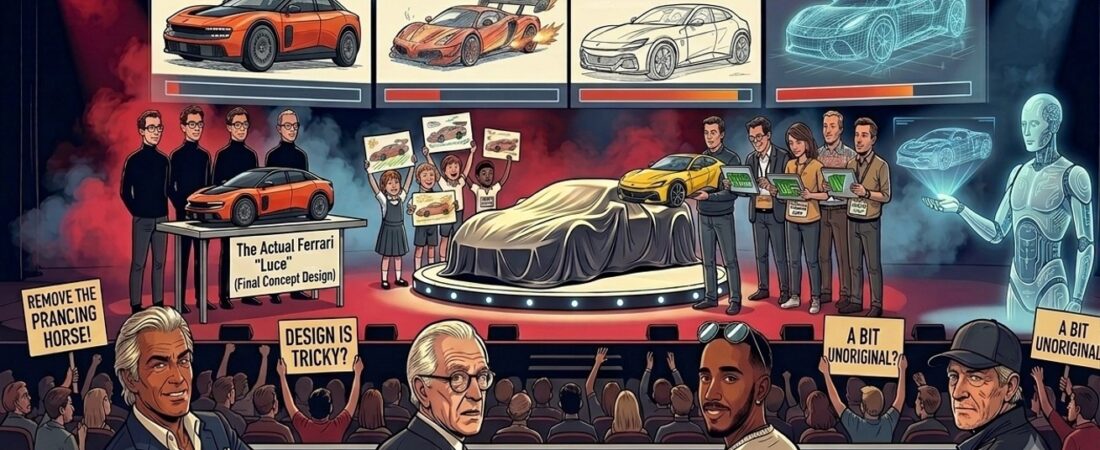
Expectations had been sky-high. Media outlets ran renderings of what the first electric Ferrari might look like. What followed was a shock — and probably the worst shitstorm in Ferrari’s history. The share price fell roughly five percent on the day. Social media reached for the cruellest possible analogies: a Honda Accord with a badge, an Apple Store minivan, a luxury toaster, a rubber boat. Italian design legend Giorgetto Giugiaro delivered a single line: „A beginner would do better.“ Flavio Briatore, the Italian F1 veteran, added that the Luce’s one big advantage was that „the Chinese will definitely not copy this model.“ And then came the verdict that mattered. Luca di Montezemolo — the iconic former chairman who ran Ferrari for over two decades — was asked directly what he thought. He stopped himself: „If I said what I really think, I would harm Ferrari.“ He went on to say Ferrari is „risking the destruction of a myth,“ asked publicly that the company at least „remove the Prancing Horse from that car,“ and reaffirmed Briattore’s statement:
„It is certainly a car that at least the Chinese won’t copy.“
Eighteen months earlier, in November 2024, Jaguar had already deleted itself. The „Copy Nothing“ rebrand erased the leaper, the visual codes, the existing model range, and — for a long, expensive interlude — even the cars themselves. The media called it „commercial suicide“ in order to become „a second Bentley.“ The result is on track to enter automotive history as the most fatal rebranding attempt of the modern era: European sales down roughly 99 percent, global volume collapsed from over 180,000 cars in 2018 to “near zero” in 2026 (in Jaguar’s own words), a UK dealer network shrinking from around 80 outlets to 20, the design chief dismissed, and the first new product slipping repeatedly to the right.
Two icons. Two opposite executions. The same strategic error. But how can such disasters happen — despite vast strategy units, armies of external consultants, and considerable market-research budgets?
Strategy Teams Gone Rogue — When Decision Makers Love Their Own Ideas Too Much
The biggest risk in product strategy is that designers, strategists and board members fall in love with their own ideas more than with the customer and the brand. Product strategy is a simple, analytical, straightforward discipline: analyse the market, the competitors and the consumer, then derive the right product answer to the consumer’s needs. Design, great engineering and a touch of creative genius add the sparkle that makes the product stand out.
Unfortunately, too many automotive product managers, marketers, designers and decision makers have drifted too far from the actual customer. Thousands of hours go into expensive market research — but hardly any decision maker ever attends a focus group or reads more than the executive summary. Market research is treated like criticism, not like a gift.
Once the mobility shift was proclaimed in Europe, a dangerous virus broke out in European automakers. Instead of embracing their own technological heritage, the ICE legacy was stigmatised — and a new, ideologically driven vision of future mobility took its place. Glossy mood boards from expensive branding agencies took over; supercars and family SUVs became large, clean and expensive at once; personas replaced market research; the target consumer became young, rich, stylish, progressive and image-perfect. Strategy papers, product concepts and retail concepts sold beautifully in board meetings and investor conferences. The ivory tower decoupled from the auto-corrective mechanisms of reality and customer feedback — while the experienced petrolheads were left out and quietly went into denial. One fact got lost in all the self-applause: in reality, the actual customer — the purpose of the entire industry — had not changed nearly as much as the PowerPoints.
Price Does Not Make an Icon
The reason both launches went wrong is the same reason: A €550,000 sticker on a four-door appliance does not buy you Ferrari status, and a „Copy Nothing“ manifesto does not buy you the future. Price does not make an icon. Spec sheets do not make an icon. Logos do not make an icon. Neither does a communication campaign.
What makes a supercar icon is the aura — a stable, tightly coded semiotic system that customers decode the instant the car comes into view, and which takes decades to build: scarcity, drama, speed made physical, the muscular and predatory aesthetic of dominance, the unmistakable sound and silhouette of a machine built for one purpose. A friendly four-door family BEV with big screens and a smiling face does not encode any of that, no matter how quickly it accelerates.
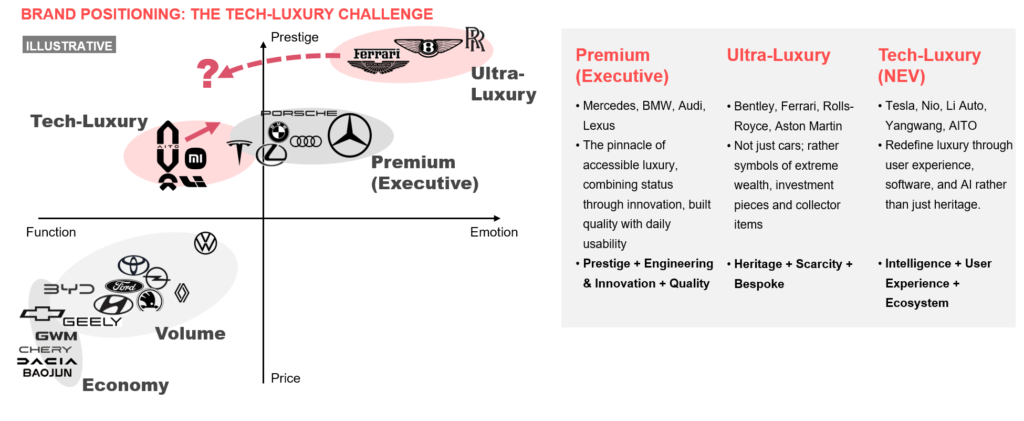
In my earlier viewpoint How Can German Premium Brands Remain Relevant in Global Markets? I mapped the automotive landscape on a positioning grid: Volume, Premium, Ultra-Luxury, and the new Tech-Luxury quadrant occupied by Tesla, NIO, Yangwang, AITO and Maextro. Ferrari sits — sat — squarely in Ultra-Luxury. The Luce is an attempt to slide it diagonally across the grid into Tech-Luxury territory: bigger interior, more screens, more software, less drama. The problem is mechanical: when you cross categories, you lose the anchor points of the one you left, and you arrive in the new one as a tourist. The challenger brands already living in Tech-Luxury — Xiaomi, Yangwang, Maextro — are better at being Tech-Luxury than Ferrari can ever be, because they have no Ultra-Luxury anchor to defend and were built around software, UX and ecosystem from day one. Crossing the grid trades a moat for a fight you cannot win.
Losing a Technology Challenge You Started Yourself
Had they remained in their own clusters, Ferrari and Jaguar would have stayed category killers. Ferrari is hugely successful: a full order book and long waitlist, the highest profit per car in the industry, Italy’s national icon, near-100% brand awareness in every kindergarten. It would have taken challengers decades to even close the gap in the minds of consumers.
Once you reposition into an entirely different cluster, new rules apply. You fight for different customers and face a different set of competitors. And once you command a price point five times higher than your nearest competitor, the buyer expects you to be the leader of the pack — that is the unwritten rule of the premium and luxury market.
Ferrari ended up as a follower. Acceleration and top speed inferior to Tesla’s Model S Plaid and Xiaomi’s SU7 Ultra. Inferior range and torque. Why would a consumer ever buy a Ferrari that cannot beat a Chinese new entrant on the Nürburgring or out-Tesla a Tesla — and fails the challenge in every dimension except price?
| Ferrari Luce | Xiaomi SU7 Ultra | Tesla Model S Plaid | |
|---|---|---|---|
| Price | €550,000 | ¥529,900 (~$73K)* | ~$99,990 |
| Seats | 5 | 5 | 5 |
| Length | 5,026 mm | 5,115 mm | 5,021 mm |
| Power | 772 kW | 1,138 kW | 761 kW |
| Torque | ~960 Nm | 1,770 Nm | ~1,420 Nm |
| 0–100 km/h | 2.5 s | 1.98 s | 2.2 s |
| Top speed | 309 km/h | 350 km/h | 322 km/h |
| Range | 530 km (WLTP)** | 630 km (CLTC)*** | 592 km (WLTP) |
* Xiaomi SU7 Ultra: China market only, not available in EU/US as of May 2026. ** Ferrari Luce EPA rating pending; first deliveries October 2026 (EU). *** CLTC cycle (~20% higher than WLTP).
What Actually Makes a Ferrari a Ferrari — and What Ferrari Now Needs to Do Better
Strip Ferrari to its strategic core and its brand values do almost all the work. But what makes up a brand like Ferrari?
1. Exclusivity, scarcity and the tribe (the Ferraristi). Ferrari has built its desirability on the principle of producing „one car fewer than the market demands.“ Scarcity is the foundational mechanism of Ferrari brand equity: scarcity of form, scarcity of badge, scarcity of access. Stretching a sports-car brand can work, when done cautiously — Porsche’s Cayenne, Ferrari’s Purosangue and Lamborghini’s Urus have proven it — but each was a stretch with the tribe, as customers moved through life stages (a 911 does not go well with a stroller, or once your back stiffens). The Luce stretches towards a different tribe. It may indeed be the better Apple car, but it was instantly memed by Ferrari’s own community as a brand-identity betrayal — at odds with everything Ferrari’s core stands for. Never alienate the tribe! They are the foundation of the brand. Stretch carefully.
2. Racing DNA and performance heritage. Scuderia Ferrari is the oldest and most decorated team in Formula 1. Every road car has historically been a controlled descent from the race car — performance is never abstract, it is traceable to the track. The Luce’s 2.5-second sprint is faster than the Purosangue, but the theatre and the spirit of performance have been stripped out. Acceleration without sound, without sculpture, without visible aggression is a spec-sheet number, not a Ferrari experience. A Ferrari should never read as cute or friendly. A 1,300-hp Tesla Model S Plaid delivers the number for a quarter of the price — what you pay extra for is the drama and the experience.
3. Innovation within tradition. The SF90 and LaFerrari hybrids pushed the envelope without ever asking the customer to choose between the engineering future and the brand heritage. The Luce inverts the formula: it is innovation against tradition. Even a customer ready to embrace electrification is being asked to also accept a new body format, a new design language, a new design author, and a new product mission, all at once. That is too many discontinuities in a single product. Ferrari has always stood for innovation and performance — in Formula 1 as on the road — but a Ferrari has always been a Ferrari. Going full BEV can be a fantastic option (although the question remains whether a hybrid is not the better answer for a super sports car, if only for the roar). But a Ferrari has to remain a Ferrari!
4. Italian design and craftsmanship. Maranello is curated as a temple: hand-stitched leather, bespoke colour, the V12 soundtrack as cultural artefact. Jony Ive and LoveFrom substituted Italian emotion for Californian minimalist restraint. There is nothing wrong with Californian minimalism — Apple built a trillion-dollar brand on it — but it is not the cultural code Ferrari encodes. The toaster comparisons are not random; they are customers correctly identifying a different semiotic system. Make the tribe feel at home, even when you swap the combustion engine for an equally expensive battery pack.
Run any Ferrari product through these four filters before launch and you have a working icon test. The Luce fails three of the four — and arguably the fourth as well. The consumer’s mind has this radar already built-in. It screens for consistency and security – even when buying a Ferrari. It won’t buy if it doesn’t feel right. Serious market research or consumer integration would have told it early. Ferrari has still time to course-correct: deliveries do not begin until Q4 2026, Tuning companies have already proposed cladding sets, the order book is famously long, and Italy still has the best designers in the world. But the icon damage was being done in public, in real time — and the company’s defence, that the Luce is „a new chapter“ and „profitable,“ answers a financial question nobody serious was asking. Bold mistakes require bold action.
The Playbook: Golden Rules for Avoiding Costly Product Fails
But how to avoid costly failures like the “Luce” and “Copy Nothing”? The answer ist remarkably simple. There are five golden rules of defining successful products:
- Get your market research right — it never lies. Run clinics, product tests, focus groups, and early consumer involvement. Listening to market research would have filtered out launches like the Luce and saved Jaguar from its costly mistake. A clinic costs you €200K, but it can save your brand.
- Use co-creation — especially in the luxury segment. Luxury buyers will rarely fill out a 20-minute survey. In 2015 I moderated the co-creation session that led to the Talagon, VW’s first co-created model. Co-creation is an extraordinarily powerful method to root products in the consumer — and to bring designers, engineers and target groups together for an immersive hackathon of creativity, exploration and mutual understanding.
- Trust your brand. Respect it, develop it carefully, let it shine. Never break the purpose, the core values, the brand promise: they are the emotional why behind the brand’s existence. Never alienate your tribe. Never break the product chain. Building a brand takes decades; product decisions can — and must — be bold, but always within the fundamental guidelines of the brand.
- Define your codes. A product is a semiotic system of symbols and expressions. Its reception is subconscious. Technical benchmarks matter, but so does the subtle message the product conveys. Storytelling through products is extraordinarily effective — get it right. The Luce did have a message — „I don’t want to be a Ferrari any more“ — but it was the wrong one. Imagine how powerful the right message of the first electric Ferrari could have been.
- The customer is the final judge. Understand your consumer and tailor the product to their needs and dreams. The truth is uncomfortable: Ferrari and Porsche customers are far older than any marketer would ever admit. Most automotive customers are far less Instagrammable than the commercials suggest. Respect their needs and dreams. And iterate, if your design fails the test.
The Chinese Already Understand This
The most painful inversion in Montezemolo’s verdict is, that the Chinese, except they are far from copying the Luce, have already shown they understand the supercar codes better than Ferrari itself.
The Xiaomi SU7 Ultra — a halo product from a brand that did not build a car until 2024 — was engineered around the visible semiotics of performance: aggressive proportions, theatrical aero, Nürburgring laps as the proof point. BYD’s Yangwang U9 is an electric supercar built around dance-mode demonstrations of independent-suspension control, a 1,300-horsepower drivetrain wrapped in unapologetically sculptural bodywork. Maextro and AITO target the ultra-luxury sedan and SUV positions Ferrari and Mercedes-Maybach have historically owned.
These brands have no heritage to protect — and that, paradoxically, has made them more disciplined readers of the segment than the incumbents. They studied what supercar customers actually respond to (drama, scarcity, theatre, sculpture, presence) and built products that deliver those codes in an electric powertrain. The powertrain is the entry card to the elitist game; the codes are how you stay at the table. Ferrari and Jaguar studied trend reports and built products that deliver a contemporary cultural posture instead.
Shaun Rein declared the End of Copycat China already in 2014. Pure copying has been over in China since the pandemic at the latest. The Chinese will advance, challenge and reinvent anything admirable that Europe builds, in a way that reflects the Chinese consumer — and they have now done exactly that with the traditional supercar, reinventing it in powertrain, experience and price. Montezemolo’s line is so devastating because it points to one bitter truth: the Luce is not too technologically advanced or too exclusive to copy – it is too undesirable to copy. And the products that are copy-worthy in the electric supercar quadrant are now probably Chinese.
A Side Note: Could AI Have Done Better?
I was asked last week whether AI could have done better. In the case of Ferrari — probably yes.
In general: No single great designer makes a great product. You need a team — a visionary product manager and marketer, a skilled concept developer, the best experts for powertrain, chassis and electronics, and, increasingly, the right geeks for autonomous driving and user experience. AI will become part of that team in every function. It will make great team members more effective. It will run research, renderings, simulations and quality tests, query consumers and probably help sell the car better. Could one fully automate product development with tools like Claude Code or comparable AI stacks? Technically, yes. Strategically, probably not. But AI will absolutely lift ideation, design-and-development effectiveness and product quality to a completely new level — if it is used to listen to customers, not to silence them.
Imagine if Ferrari had used AI alongside the design sketches to iterate the Luce concept and test it with consumers. The outcome would have been a real supercar.
In my forthcoming book Totalschaden? (Q4/2026), I argue under the „Operation Phoenix“ framework that European OEMs must match the speed and cost discipline of their Chinese challengers. But speed without continuity is just a faster way to destroy value. The icon — Ferrari’s myth, Jaguar’s heritage, Porsche’s silhouette, Mercedes‘ three-pointed star, the M and the quattro — is the one asset Stuttgart, Maranello and Coventry hold that Shenzhen cannot reverse-engineer. The strategic task of the electric decade is not to escape that heritage. It is to carry it across — intact, evolved, and still wearing its badge.
Coming next: my following viewpoint on „How to Develop the Car of the Future — how AI, co-creation and customer-led product strategy reshape the next decade of automotive product development.„